

One crucial component of contemporary production is plastic. The colour, texture, and utility of the finished product are now crucial factors in determining its quality. This is where Masterbatch comes in. It determines the best prices, increases manufacturing efficiency, and improves the quality of plastic. This article will define masterbatch and discuss its potential applications in plastics manufacturing if you are not familiar with the word.
What is Masterbatch?
A concentrated blend of pigments or additives covered in a carrier resin is called a masterbatch. It is applied to raw polymers to colour them or enhance their characteristics. Manufacturers use masterbatch for uniform dispersion, improved quality control, and increased manufacturing efficiency rather than adding additives or raw pigments individually. It streamlines the manufacturing process, guaranteeing plastic goods’ quality and uniformity.
What Are the Different Types of Masterbatch?
Masterbatches are formulated for different purposes depending on the required properties and application of the final plastic product. The most common types include:
Colour Masterbatch
Colour masterbatch contains concentrated pigments that give plastic products a consistent and attractive colour. It is widely used for packaging, household products, toys, containers, pipes and other plastic products where appearance and colour consistency are important.
Black Masterbatch
Black masterbatch is commonly formulated with carbon black and is used to provide deep, uniform black colour. Depending on its formulation, it can also provide properties such as UV protection and improved opacity.
White Masterbatch
White masterbatch generally uses titanium dioxide as the primary pigment to provide whiteness, brightness and opacity. It is used in films, packaging, containers, household products and many other plastic applications.
Additive Masterbatch
Additive masterbatch is designed to improve the functional properties of plastic rather than simply changing its colour. Depending on the formulation, it can provide UV resistance, anti-static properties, flame retardancy, slip, anti-blocking, anti-oxidation and other performance characteristics.
Filler Masterbatch
Filler masterbatch contains mineral fillers such as calcium carbonate or talc. It can help modify the physical properties of plastic while potentially reducing the overall material cost in suitable applications.
Engineering Masterbatch
Engineering masterbatch is formulated for demanding plastic applications where specific performance characteristics are required. It can be used with engineering polymers such as ABS, nylon, PET, PBT, PC and HIPS.
Types of Masterbatch
There are various masterbatch types, including:
| Type | Benefits & Functions |
| Black Masterbatch | It offers rich black pigmentation, great opacity, and UV stability. |
| White Masterbatch | It ensures excellent opacity and brightness, which makes it perfect for use in medical and food packaging applications. |
| Colour Masterbatch | It adds brilliant, personalised colours with superior uniformity and dispersion. |
| Additive Masterbatch | It enhances qualities including processing stability, flame retardancy and anti-static. |
| Filler Masterbatch | It increases mechanical strength while lowering the cost of raw materials. |
| Special Effect Masterbatch | It produces metallic, pearlescent shine and distinctive textures. |
| Engineering Masterbatch | It creates high-performance polymers for industrial and automotive uses. |
| PET Masterbatch | It is specifically designed for use in PET, ensuring durability for bottles and films over time. |
What Role Does Masterbatch Play in Plastics Production?
The masterbatch is combined with the basic resin throughout the manufacturing process. Hence, colour and additive dispersion are uniformly carried out. The outcome comes as homogeneity, cost efficiency and enhanced product performance.
Masterbatch enhances plastic production by offering the following:
- Uniform Dispersion: Ensures consistent distribution of colour and additives.
- Improved Processability: Improves plastic flow, thus minimising defects.
- Increased Cost Efficiency: Saves on expensive pure pigments or additives.
- Durability & Protection: Provides UV resistance (for black masterbatch), anti-static, and other protective properties.
Types of Moulding & Masterbatch Applications
Masterbatch applications range widely in most plastic processing technologies, including:
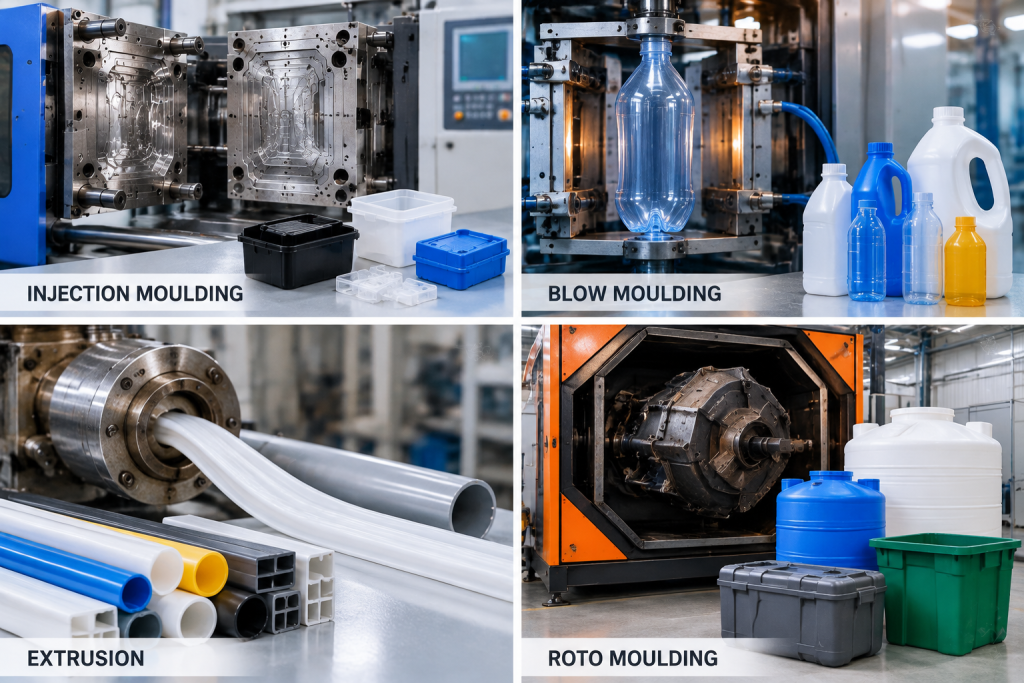
1.Injection Moulding
Packaging materials, automobile parts, and home items are all made using injection moulding. Colour and white masterbatches provide increased toughness, aesthetic appeal and finish quality.
2.Blow Moulding
Bottles, containers, and other hollow plastic products are made by blow moulding. Black masterbatch aids in preventing UV deterioration, while colour masterbatch guarantees vivid finishes.
3.Extrusion
Extrusion is applied in the fabrication of agricultural films and pipes. In an outdoor environment, a black masterbatch, which is UV stabilised, ensures durability since it increases robustness.
4.Roto Moulding
Roto moulding applies to large-sized hollow plastic parts such as industrial containers, furniture, tanks, etc. Masterbatch promotes weatherability and impact resistance coupled with good-quality surface.
Benefits of Using Masterbatch
Masterbatch in plastic production offers many benefits, which is why it is an integral part of modern manufacturing.
1.Better Processability
Masterbatch enhances the flow properties of plastics, thereby reducing defects and ensuring smooth production.
2.Cost Optimisation
Filler masterbatch helps manufacturers save on raw material costs while maintaining the mechanical strength of the product.
3.Better UV Protection
Products exposed to sunlight require UV masterbatch to prevent degradation and maintain colour stability.
4.Environmental Benefits
Masterbatch reduces waste by allowing precise dosing, minimising excess colourant usage.
5.Superior Aesthetic Quality
With Colour Masterbatch, manufacturers can achieve vibrant, consistent hues in plastic products without streaking or uneven distribution.
Industries Benefits from Masterbatch
Masterbatch finds application across diverse industries due to its versatility and effectiveness.
| Industry | Application |
| Packaging | PET bottles, food containers, films |
| Automotive | Dashboard components, trims, bumpers |
| Agriculture | Greenhouse films, irrigation pipes |
| Toys | Vibrant, durable plastic toys |
| Electrical | Wire and cable insulation |
Check Our Full Range of Applications
Choosing the Right Masterbatch Supplier
The right masterbatch manufacturer is key to quality, consistency, and innovation. Kothari Polymers is well known for its superior masterbatch solutions that are customised to fulfil a variety of industrial requirements. We have been providing high-quality masterbatch products in India and abroad for over 35 years.
Here’s what distinguishes Kothari Polymers:
- Customized Colour Solutions: Colour masterbatches are created to meet the specific requirements of the customers.
- Shade matching between RAL and Pantone: Perfect shade matching meeting international colour standards.
- Wide Colours Range: A vast array of colours is available for any kind of requirement.
- High-Performance Masterbatches: Innovative solutions to many industrial challenges.
- Global Reach: Offering premium masterbatches in Australia, Canada, the United States, and India.
How to Choose the Right Masterbatch
Choosing the right masterbatch depends on the polymer, processing method, required properties and final application. Manufacturers should consider the following factors before selecting a formulation:
- Base polymer: Check that the carrier system is compatible with the polymer being processed.
- Processing method: Injection moulding, blow moulding, blown film, extrusion and other processes may require different formulations.
- Required colour or property: Determine whether the requirement is colouration, UV protection, anti-static performance, flame retardancy, improved processing or another function.
- Dosage requirement: Follow the recommended addition rate for the selected formulation rather than assuming that the same dosage applies to every application.
- Dispersion quality: Good dispersion is important for achieving consistent colour and functional performance.
- End-use requirements: Packaging, agriculture, automotive, household, electrical and industrial products can have different performance requirements.
- Quality and consistency: Choose a supplier that can provide consistent formulations and quality control between batches.
Selecting a masterbatch based on the complete application rather than colour or price alone can help manufacturers achieve more reliable production results.
Get Professional Advice by Getting in Touch with Us!
Do you want to produce plastics with the best masterbatch solutions? Kothari Polymers has developed high-performance masterbatches with a range of applications. Contact us now for the best products and expert advice!